Javed Khan — Licensed Concreter BLD 317725Concrete Driveways
5 Signs Your Concrete Driveway Needs Replacing (Adelaide Homeowner Guide)
Title: 5 Signs Your Concrete Driveway Needs Replacing (Adelaide Homeowner Guide)
---
Concrete driveways are durable — a well-installed one should last 25–40 years. But they don't last forever, and Adelaide's reactive clay soils accelerate wear on driveways that weren't engineered correctly in the first place. Here's how to tell when repair is possible, and when replacement is the smarter move.
---
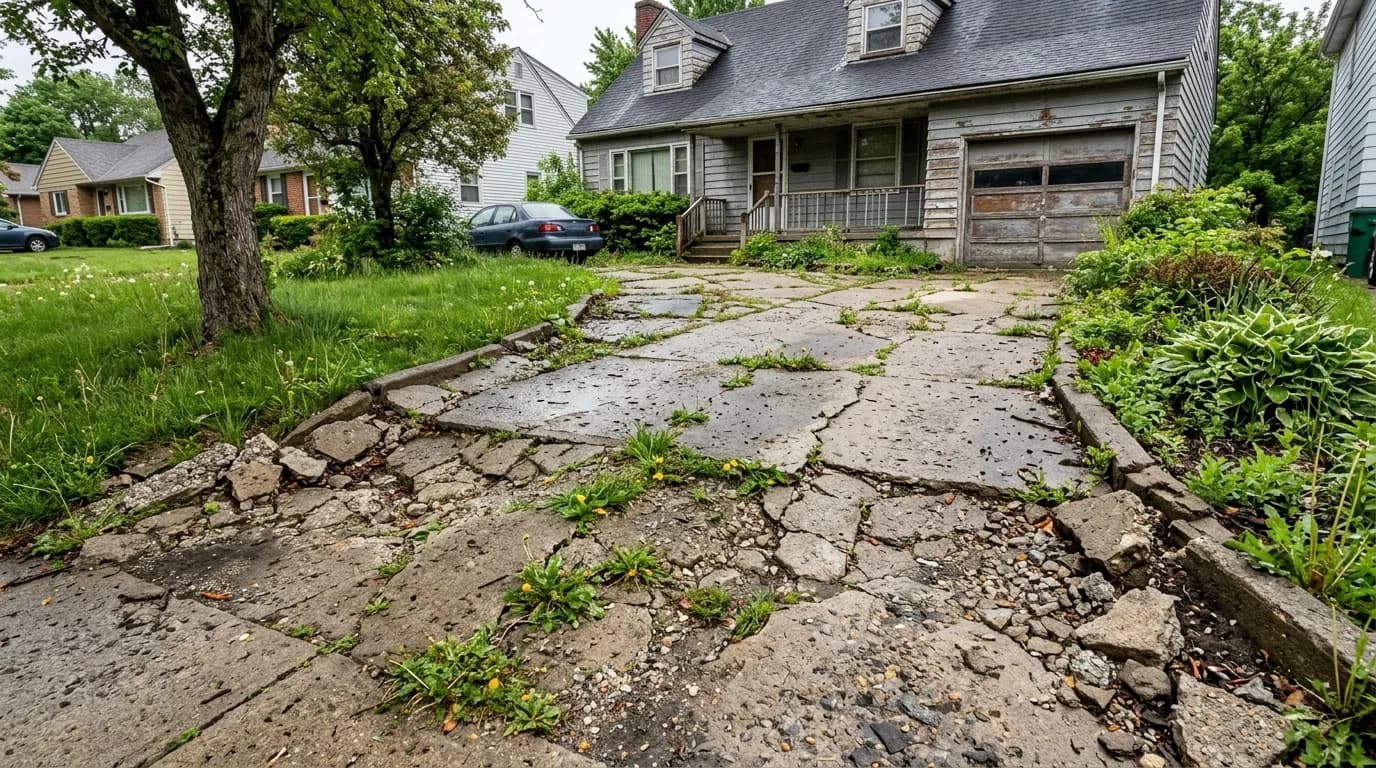
Sign 1: Multiple Large Cracks (Especially Interconnected)
Not all cracking is a problem. Hairline cracks along control joints are normal and expected — the joints are placed there specifically to manage cracking. Random hairline cracks on the surface don't compromise structural integrity.
What's a problem:
- Cracks wider than 5mm
- Cracks that run diagonally across the slab (not along joints)
- Multiple interconnected cracks forming a "map crack" or spider web pattern
- Cracks where one side has risen or sunk relative to the other (differential settlement)
Adelaide-specific context: Northern suburbs (Salisbury, Elizabeth, Para Hills) and southern suburbs (Morphett Vale, Reynella) have reactive clay soils that cause ground movement with seasonal moisture changes. Driveways poured 15–20+ years ago without adequate reinforcement or base preparation on these soils often show this pattern of multiple differential cracks. Patching individual cracks doesn't address the underlying cause — the ground movement will crack a new patch just as quickly.
Repair vs replace: Single crack with no differential movement — repair. Multiple cracks, differential movement, or interconnected cracking — replace.
---
Sign 2: Sinking or Heaving Sections
If one section of your driveway has sunk lower than adjacent sections, or if a section has pushed upward (heaved), you have a structural ground issue — not a surface issue.
Sinking is caused by:
- Sub-base compaction failure (base material that was never properly compacted)
- Erosion of sub-base material by water (ponded water under the slab)
- Tree root removal that left voids under the slab
Heaving is caused by:
- Reactive clay expanding under the slab from moisture increase
- Tree root growth pushing up from underneath
- Frost heave (rare in Adelaide metro but possible in elevated hills suburbs in winter)
Differential settlement creates trip hazards at slab edges and causes water to pond in the wrong direction — toward the house instead of away from it.
Repair vs replace: Slab grinding can chamfer a raised edge to remove a trip hazard, but it doesn't fix the underlying cause. If sections have sunk or heaved by more than 20–30mm, replacement is usually more cost-effective than grinding and patching.
---
Sign 3: Surface Scaling, Spalling, or Delamination
Surface scaling is when the top layer of the concrete flakes or peels away, exposing the aggregate below in an uneven, rough pattern. It's different from exposed aggregate (which is uniform and intentional) — scaling is irregular and progressive.
Common causes in Adelaide:
- Under-watered concrete surface during Adelaide's hot, dry summer pours
- Concrete trowelled while bleed water was still coming to the surface (traps water under a dense top layer that later fails)
- De-icing salt use (rare in Adelaide's climate but relevant if salt was used on an icy driveway in a hills suburb)
- Very old concrete (30+ years) that has simply reached end of design life
Repair vs replace: If scaling is shallow (less than 5mm) and covers less than 20% of the surface, a resurfacing overlay is possible. If scaling is deep or widespread, the slab surface has failed and replacement gives better long-term value.
---
Sign 4: Drainage Problems
A well-designed concrete driveway should always slope away from the house — typically a 1:60 to 1:80 fall toward the street or a side drain. If water ponds anywhere on the driveway surface, particularly near the garage apron or adjacent to the house foundation, you have a drainage problem.
Signs of drainage failure:
- Water pooling after rain instead of running off
- Water pooling against the garage door threshold (rust staining, water ingress)
- Green algae or moss growth on areas that stay damp
- Water marks on the house foundation or garage wall
Adelaide's summer storm events bring heavy rain after months of drought — a driveway that can't drain quickly is more damaging than one in a wetter climate.
Repair vs replace: If the existing slab was poured without falls (flat or slightly inverted), there is no repair option — the slab must be replaced with correctly graded formwork. If a drain has blocked or failed, sometimes remedial drainage works can be added without full slab replacement.
---
Sign 5: Age and Cumulative Wear
Concrete driveways have a design life — in Adelaide's climate, this is typically 25–40 years for a properly installed slab. Beyond this point, even a crack-free looking slab may have lost significant structural integrity due to:
- Progressive carbonation (which reduces the alkalinity that protects the reinforcing steel)
- Steel reinforcement corrosion (rust expands and cracks the surrounding concrete from within)
- UV degradation of the surface binder
- Cumulative fatigue from vehicle loading
If your driveway was poured in the 1980s or 1990s, it may be approaching or past its design life — particularly if it was installed by a previous owner without documentation of mix design or reinforcement specification.
Repair vs replace: A 30+ year old slab showing any of the above signs is usually at the point where replacement is a better investment than repeated repairs.
---
Cost of Replacement vs Cost of Delaying
A standard Adelaide double driveway replacement (40–50 m²) in exposed aggregate costs approximately $3,600–$7,500. Delaying replacement when multiple signs are present means:
- Progressive cracking that widens and creates more trip hazards
- Water ingress damage to the sub-base, requiring deeper excavation when you do eventually replace
- Potential damage to adjacent structures (garage apron, footpath connection) if differential settlement continues
- Reduced property value and curb appeal
Most homeowners who replace a failed driveway wish they had done it 2–3 years earlier.
---
Get a Free Assessment
If you're seeing any of these signs on your Adelaide driveway, we offer a free site assessment and written replacement quote — no obligation.
Call Javed on 0466 801 058 or fill in the contact form. BLD 317725 · Own crew · Written quote within 48 hours.
---
FAQs
Can cracked concrete be repaired rather than replaced?
Minor cracks along control joints can be sealed with a flexible polyurethane crack filler. This prevents water ingress and weed growth. Structural cracks — particularly differential cracks where one side has moved relative to the other — can't be durably repaired and are a sign of sub-base or ground movement that patching won't fix.
How do I know if the cracking is from ground movement or a pour defect?
Ground movement cracks are typically diagonal, follow soil boundaries, and often occur at the same pattern across the slab as the underlying soil profile. Pour defects (plastic shrinkage, alkali-silica reaction) create map cracking patterns and usually occur earlier in the driveway's life. We can diagnose the likely cause during the site assessment.
What's the cheapest way to fix a driveway that's cracked but not yet failed?
Crack sealing + resurfacing overlay. An overlay (50–75mm of new concrete or polymer-modified resurfacer) can extend the life of a sound but surface-damaged slab by 8–12 years. The slab underneath must be structurally sound with no differential movement. We assess this at the site measure.
---
Published: 28 June 2026 · Opal SA Construction · BLD 317725
---
---
Relevant Services & Concreting Guides
Planning a concreting project at your Adelaide property? Explore our specialized services: