Javed Khan — Licensed Concreter BLD 317725Concrete Driveways
How Thick Should a Concrete Driveway Be? (Australian Standards Explained)
Concrete driveway thickness is one of those details most Adelaide homeowners never think about until the concrete fails — and by then it's too late to fix without ripping it all up.
The good news: Australian Standards give us clear minimum requirements, and understanding them takes 5 minutes. Here is what you need to know before your concreters arrive on site.
The Australian Standard Minimum: 100 mm
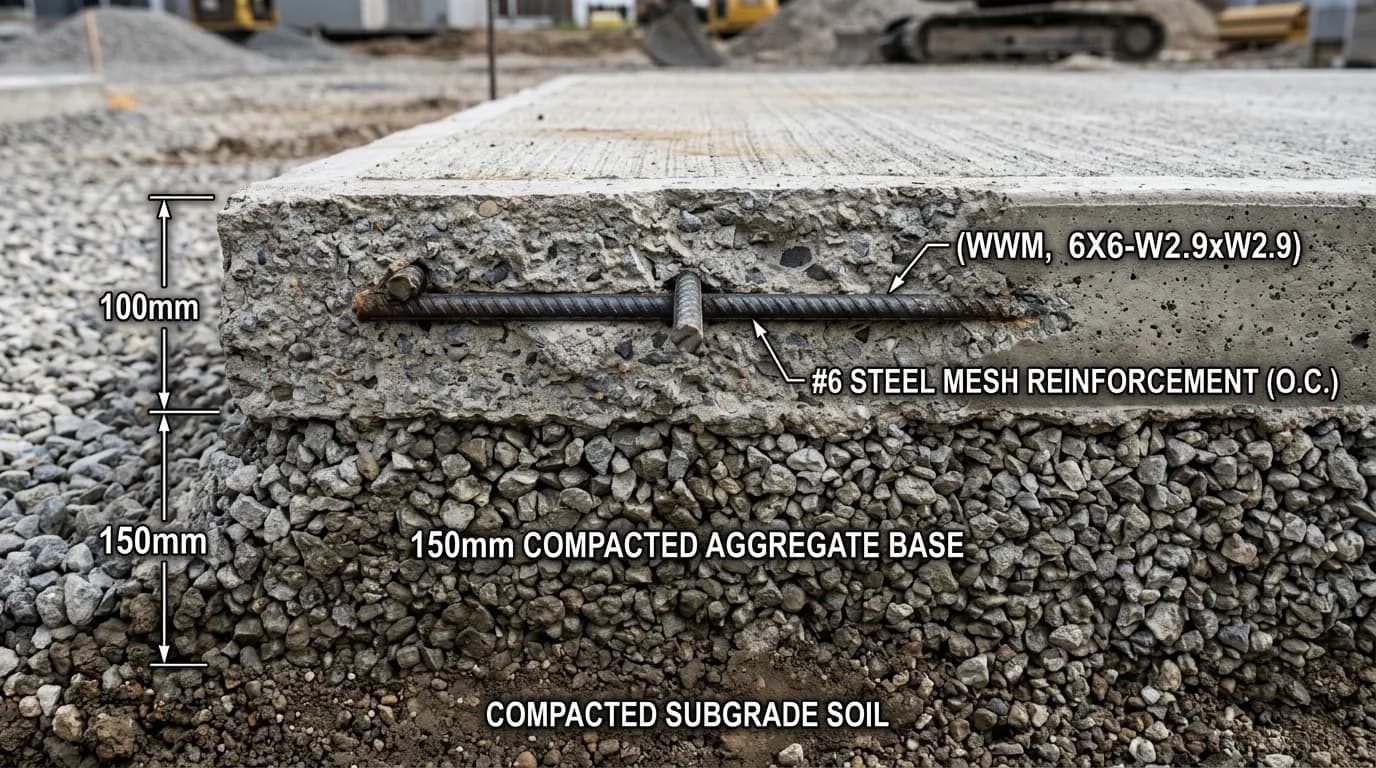
For residential concrete driveways in Australia, the baseline minimum thickness is 100 mm (10 cm), as recommended under AS 3600 (Concrete Structures) and widely adopted across the residential building industry.
At 100 mm with SL72 reinforcement mesh, a standard residential driveway can handle:
- Passenger vehicles (up to 3 tonnes)
- 4WDs and SUVs
- Light trailers and camper vans
This is the standard we use at Opal SA Construction for all residential driveways unless the site or application demands more.
When You Need More Than 100 mm
Some situations call for a thicker pour:
| Application | Recommended Thickness | Reason |
|---|---|---|
| Standard residential driveway | 100 mm | Passenger vehicles only |
| Driveway with trailer access | 125 mm | Frequent heavier loads |
| Concrete in front of garage (turning area) | 125 mm | Point loads from reversing |
| Driveway accessed by trucks (removalist, concrete) | 150 mm | Heavy vehicle axle loads |
| Class H1/H2 reactive clay soils (northern/southern Adelaide) | 100–125 mm + deeper roadbase | Soil movement resistance |
| Commercial car park (light vehicles) | 125–150 mm | Continuous traffic |
The Role of Reinforcement
Thickness alone is not enough. What's underneath — and inside — the concrete matters equally:
Reinforcement mesh:
- SL72 mesh (7.1 mm bar, 200 mm centres) — standard for passenger vehicles
- SL82 mesh (8.9 mm bar, 200 mm centres) — recommended for reactive clay sites in Adelaide's north and south
Compacted roadbase:
- Minimum 100 mm DGB20 (compacted) under every residential slab
- 150 mm on Class H1/H2 soil sites (Salisbury, Gawler, Morphett Vale)
- Compaction tested to 95% standard proctor density — poorly compacted roadbase causes slab cracking regardless of concrete thickness
Moisture barrier:
- 0.2 mm polyethylene sheet between roadbase and concrete on all slab-on-ground work
- Prevents moisture migration from subsoil into the slab (critical in Adelaide's reactive clays)
Adelaide Soil Conditions and What They Mean for Thickness
Adelaide's soil reactivity directly affects what thickness and reinforcement your driveway needs:
| Zone | Suburbs | AS 2870 Class | Recommended Thickness |
|---|---|---|---|
| Coastal / inner west | Glenelg, Henley Beach, Port Adelaide | Class A/S | 100 mm standard |
| Inner eastern | Norwood, Unley, Campbelltown | Class M | 100 mm standard |
| Northern corridor | Salisbury, Elizabeth, Para Hills, Gawler | Class H1–H2 | 100–125 mm + deeper base |
| Southern corridor | Morphett Vale, Reynella, Hallett Cove | Class H1 | 100–125 mm |
| Hills fringe | Mitcham, Blackwood, Burnside | Class E | Engineer assessment |
Before we quote any job in Adelaide, we check the AS 2870 soil classification for the suburb. If you are in a H-class or E-class area, we factor that into the slab design.
How Concrete Thickness Affects Cost
Adding 25 mm to a 30 m² driveway adds roughly 0.75 cubic metres of concrete — about $150–$200 in materials. Included in the installed price, the difference between 100 mm and 125 mm for a standard driveway is typically $3–$5 per m².
That is a small premium that can prevent thousands of dollars in repairs in a reactive clay zone.
The Difference Between Depth and the Overall Slab Build-Up
When concreters talk about "100 mm concrete", they mean the concrete layer only. The total excavation depth is deeper:
| Layer | Typical depth |
|---|---|
| Concrete | 100 mm |
| Compacted roadbase | 100–150 mm |
| Excavation for reactive clay sites | Extra 50–100 mm |
| Total excavation from finished surface | 200–350 mm |
This is why quotes vary — what looks like "just pouring concrete" actually involves significant earthworks, base preparation, and compaction before the concrete goes down.
Questions to Ask Your Concreter
Before you sign a quote, confirm:
What thickness is your quote based on? (Should be at least 100 mm)
What reinforcement mesh are you using? (SL72 minimum; SL82 on reactive clay)
How deep is the roadbase? (100 mm minimum compacted DGB20)
Are you including a moisture barrier? (Required on slab-on-ground in SA)
How do you handle the soil conditions in this suburb?
If a concreter cannot answer these questions specifically, they may be cutting corners on the slab specification.
Summary
- 100 mm is the minimum for residential driveways in Australia
- 125 mm is recommended for trailer access, reactive clay zones, or turning areas
- Reinforcement and roadbase compaction matter as much as thickness
- Adelaide's H-class soils in the north and south need extra care
- The cost difference is $3–$5/m² — worth paying on reactive clay sites
For a free on-site assessment of your site's soil conditions and the right slab specification for your suburb, call Javed on 0466 801 058 or request a free written quote.
Internal links to include:
Relevant Services & Concreting Guides
Planning a concreting project at your Adelaide property? Explore our specialized services: