Javed Khan — Licensed Concreter BLD 317725Concrete Driveways
Concreting in Adelaide Summer: What You Need to Know About Heat
Title: Concreting in Adelaide Summer: What You Need to Know About Heat
---
Adelaide regularly records temperatures above 40°C in summer. That's hard on people, hard on gardens, and hard on fresh concrete. If you're planning a driveway, patio, or slab in the warmer months, here's what you need to know — and what separates contractors who manage it properly from those who don't.
---
Why Heat Is Hard on Concrete
Concrete's strength comes from the hydration reaction between cement and water. This reaction needs water — and Adelaide's summer heat evaporates water from the surface faster than the reaction can use it.
The effects of a hot-weather pour done without mitigation:
Reduced surface strength
The top 5–10mm of a driveway cures faster than the body of the slab. In extreme heat, this top layer can cure so quickly that it becomes a weak, dusty surface that separates from the stronger slab below. This is why some driveways installed in summer have a powdery surface that rubs off under foot traffic.
Plastic shrinkage cracking
Concrete shrinks as it loses moisture. If the surface loses moisture much faster than the body of the slab, differential shrinkage causes fine cracks within the first few hours. These cracks are visible by the end of pour day and are a sign of inadequate heat management.
Lower 28-day strength
The Australian Concrete Institute's research shows that concrete poured above 35°C without admixtures and curing measures can achieve 10–15% less than its design strength at 28 days.
Shorter working window
Hot weather accelerates the initial set. A concrete crew has approximately 60–90 minutes after placement to complete finishing operations (screeding, floating, broom finish, or aggregate washing) before the concrete becomes unworkable. At 40°C, this window can shrink to 30–40 minutes — not enough time on a large pour.
---
What Good Contractors Do Differently
1. Schedule for morning pours
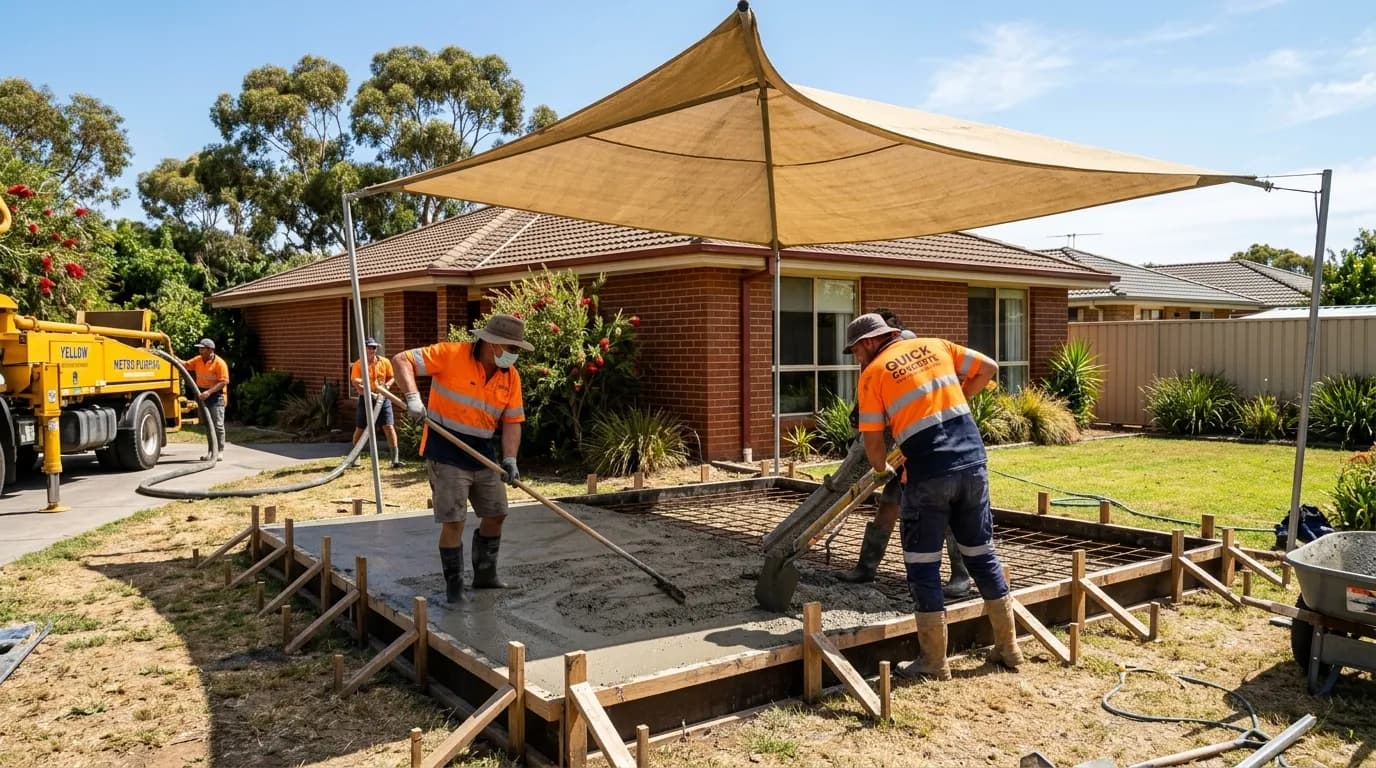
Concrete placed at 6–7am when the surface temperature is 20–25°C has a much longer working window than concrete placed at 2pm when surface temps hit 55°C. We start pours as early as 6am on forecast hot days.
2. Pre-wet the formwork and base
Dry timber forms and a dry aggregate base absorb water from the mix. Wetting them before the pour reduces the moisture loss from the concrete's bottom layer.
3. Use an evaporation retarder
An evaporation retarder (such as Confilm or equivalent) is sprayed on the fresh surface between finishing operations to slow moisture loss. This buys time for the finishing crew and reduces plastic shrinkage crack risk.
4. Apply curing compound immediately
Within 20 minutes of final finishing, a membrane-forming curing compound is applied. This forms a thin film that prevents moisture evaporation while the hydration reaction proceeds. On a hot day, this step is non-negotiable.
5. Cover with hessian on extreme heat days
On days above 38°C, we cover the finished slab with wet hessian held off the surface. This keeps the microclimate at the concrete surface 10–15°C cooler than ambient air temperature.
6. Avoid the pour entirely if conditions are unsuitable
There are days where responsible contractors simply don't pour. If the forecast shows 42°C+ with a hot northerly, we reschedule. The rescheduling cost is zero. The cost of a failed pour on a 1,000-day-old driveway is several thousand dollars.
---
Red Flags: What to Watch For
If you're getting quotes or watching work in progress during summer, these are warning signs:
- Contractor arrives at 10am on a 38°C day with no plan for heat mitigation
- No curing compound applied after finishing
- Surface covered with plastic sheeting directly on the concrete (plastic in direct contact traps heat rather than moderating it — hessian or insulated blankets are better)
- Aggregate washing done too late (surface has hardened too much — the result is shallow aggregate with loose stones)
- Broom finish applied while bleed water is still on the surface (traps water under a dense surface layer)
---
Winter: Adelaide's Best-Kept Concrete Secret
Adelaide's winter is actually excellent for concrete. June–August temperatures of 10–18°C are close to ideal for the hydration reaction — slow enough to allow more complete crystal formation, cool enough to prevent rapid moisture loss.
The practical results:
- More time for the finishing crew to achieve consistent surface quality
- Less risk of plastic shrinkage cracking
- Stronger 28-day strength (often 5–10% above the designed value)
- Better colour consistency on coloured and exposed aggregate finishes
Winter is also typically our less-busy season — which usually means shorter lead times and, in some cases, better pricing on larger jobs.
---
Autumn and Spring: Ideal
If you have flexibility on timing, March–May and September–October are ideal for concrete pours in Adelaide. Temperatures are moderate, days are long enough for early starts, and the ground is neither baked hard nor saturated. This is when the best results are easiest to achieve.
---
Planning Your Summer Concrete Project
If you need concrete work done in summer and can't wait:
Choose a contractor with explicit hot-weather protocols — not just "we're experienced" but specific measures (early starts, curing compound, retarders)
Schedule for early morning — make sure the contractor is set up before 7am on the pour day
Plan for 7-day minimum before vehicle use — same as any season, but stick to it more strictly in summer
Don't schedule the pour for a forecast 40°C day — be willing to reschedule for the next cooler window
We're happy to discuss the best timing for your project during the site visit.
Call Javed: 0466 801 058 — or get a free written quote.
---
FAQs
What temperature is too hot to pour concrete?
The practical upper limit for concrete placement without special measures is around 32°C ambient air temperature. Above 35°C, heat mitigation measures are necessary. Above 38°C, we typically reschedule unless conditions are very favourable (early morning, low wind, shaded site). The concrete mix itself can handle heat — the surface is the vulnerable part.
Does concrete cure faster in summer?
It reaches initial set faster — which shortens the working window. But "curing" (the ongoing hydration reaction that builds strength) is not faster — in fact, excessively fast initial set can interrupt curing and reduce final strength. Concrete that sets too fast in summer can be weaker at 28 days than the same mix placed in cooler conditions.
Can I water my new concrete to keep it cool?
Light misting of the surface (not flooding) in the first 24 hours can help on very hot days. This is called wet curing and is one of the oldest and most effective curing methods. However, direct garden hose pressure on fresh concrete can damage the surface finish. If you want to wet-cure, use a fine mist and do it gently. Your contractor should be doing this as part of the curing protocol — ask them about it.
---
Published: 12 July 2026 · Opal SA Construction · BLD 317725
Relevant Services & Concreting Guides
Planning a concreting project at your Adelaide property? Explore our specialized services: