Javed Khan — Licensed Concreter BLD 317725Concrete Driveways
How Long Does Concrete Take to Cure in Adelaide? (Summer vs Winter)
Title: How Long Does Concrete Take to Cure in Adelaide? (Summer vs Winter)
---
"How long before I can drive on it?" is one of the first questions homeowners ask after a concrete pour. The answer depends on the time of year — Adelaide's climate has a significant effect on how concrete cures, and understanding it helps you plan your project.
---
The Standard Curing Timeline
Regardless of season, these are the minimum times before each use level:
| Use | Minimum Wait |
|---|---|
| Walk on it | 24–48 hours |
| Light foot traffic (children, pets) | 48 hours |
| Move furniture / garden pots | 3 days |
| Passenger vehicle | 7 days |
| Heavy vehicle (caravan, truck) | 28 days |
| Full design strength (28-day cure) | 28 days |
These times assume normal temperature conditions (15–25°C). Adelaide's climate — hot dry summers and mild winters — shifts these timelines in both directions.
---
How Adelaide's Summer Heat Affects Curing
Concrete doesn't dry — it hydrates. The cement particles react chemically with water in the mix, gradually forming the crystalline structure that gives concrete its strength. This reaction is slowed by cold and accelerated by heat — but too fast is as bad as too slow.
In Adelaide's summer (December–February), air temperatures regularly exceed 35°C and surface temperatures on exposed concrete can reach 50–55°C. This causes:
1. Rapid moisture loss
Water evaporates from the surface before it can complete the hydration reaction. The result: a weaker, more porous surface layer that dusts easily, stains readily, and may crack.
2. Plastic shrinkage cracking
If the surface dries faster than the body of the concrete, surface tension causes hairline cracks within the first few hours of placement. These are different from structural cracks — they're shallow but unsightly and may compromise surface durability.
3. Reduced 28-day strength
Research by the Australian Concrete Institute shows concrete poured above 35°C with no mitigation can achieve 10–15% less 28-day strength than the same mix poured at 20°C.
What a good contractor does in Adelaide summer:
- Schedules pours for early morning (6am starts when possible)
- Wets the sub-base and formwork before pouring to reduce heat absorption
- Uses an evaporation retarder spray on the fresh surface
- Covers with hessian or curing blankets immediately after finishing
- Avoids pouring when temperatures exceed 38°C or when a hot northerly is forecast
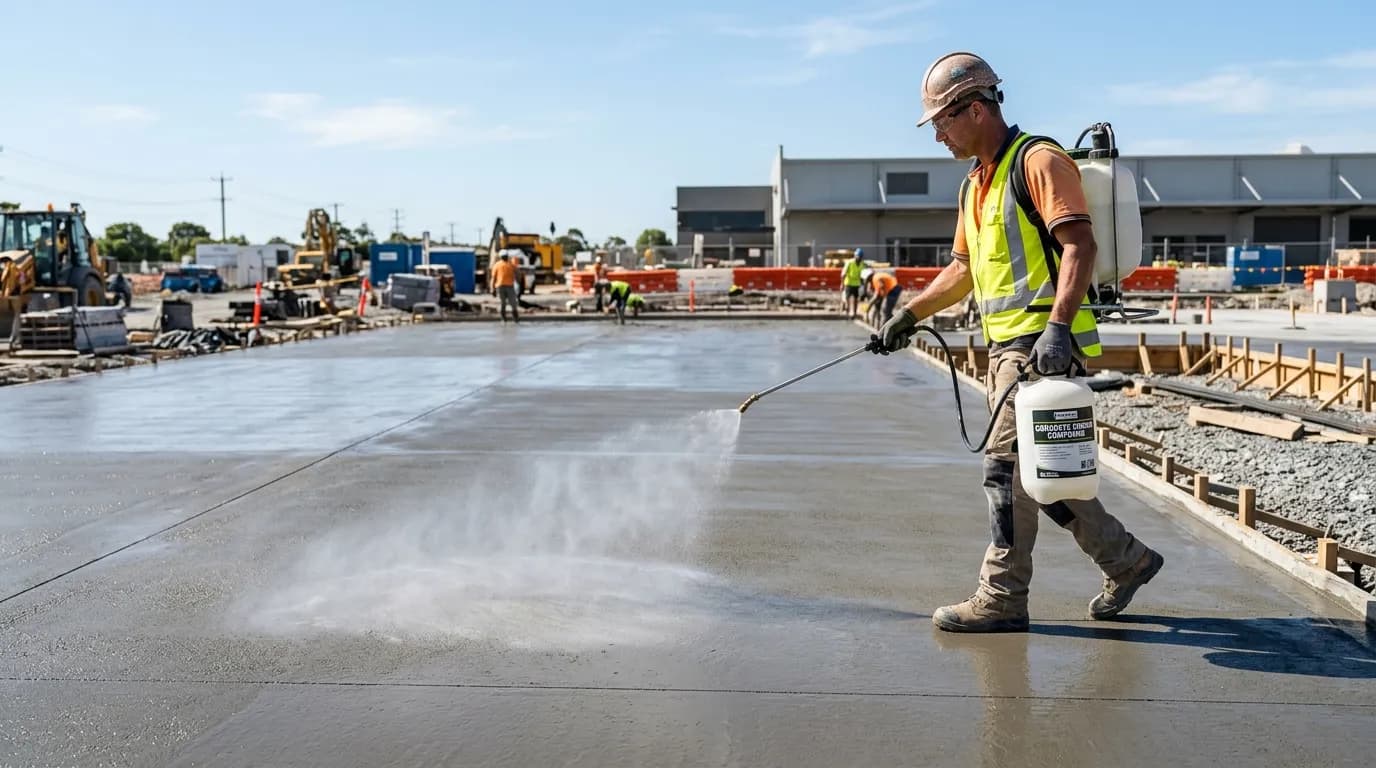
- Uses a curing compound (applied within 20 minutes of finishing) to seal the surface
We won't pour a driveway or slab on a 40°C day without heat mitigation measures. If that means rescheduling, it's worth it — the concrete will be stronger and more durable.
---
How Adelaide's Winter Supports Better Curing
Adelaide winters (June–August) are ideal for concrete pours. Typical temperatures of 10–18°C sit in the sweet spot for the hydration reaction — slower than summer, but allowing more complete crystal formation and higher ultimate strength.
The main risk in winter: temperatures below 5°C. Below 5°C, the hydration reaction essentially stops. In Adelaide's metro area, overnight winter temperatures rarely drop below 5°C at sea level — but in higher-elevation suburbs like Blackwood, Mitcham, and parts of Tea Tree Gully, near-freezing nights can occur in July.
For winter pours in elevated suburbs, we:
- Schedule pours for mid-morning (after the overnight cold has passed)
- Avoid pouring when the overnight forecast is below 5°C within 24 hours of the pour
- Use insulating blankets on freshly poured concrete if a cold snap is forecast
- Add a strength-accelerating admixture on very cold days to maintain hydration rate
The practical result: Winter concrete in Adelaide is often stronger at 28 days than the same mix poured in summer — and the surface finish quality is more consistent because there's no evaporation race against the heat.
---
What "Curing" Actually Means
There's a common misconception that concrete is "cured" when it's hard enough to walk on. It isn't. The hydration reaction continues for months after placement:
| Age | Approximate Strength as % of 28-day target |
|---|---|
| 1 day | 20–25% |
| 3 days | 45–55% |
| 7 days | 65–75% |
| 14 days | 85–90% |
| 28 days | 100% (design strength) |
| 90 days | 110–120% |
| 1 year | 120–130% |
The "28-day cure" is the benchmark used in Australian Standards (AS 3600) because 28 days is when the concrete reaches its minimum specified design strength. After that it continues to gain strength for years.
---
Exposed Aggregate Curing — Extra Consideration
Exposed aggregate concrete has an additional curing consideration: the retarder timing.
The washing step (which exposes the aggregate) must happen within a specific window — typically 8–18 hours after the pour, depending on temperature. Too hot (summer) and the window closes faster; too cold (winter) and it extends. A good crew will come back at exactly the right time, even if that means a 5am return visit on a hot day.
After washing, the exposed aggregate surface still needs 28 days to reach full strength. During this time the surface should not be sealed (sealing requires full cure).
---
Practical Planning Advice
- Summer: Plan for a possible morning pour (6am start). Budget an extra day in the schedule for heat-mitigation setup. Your driveway is usable in 7 days, but avoid parking heavy vehicles for 28 days.
- Winter: Best time to pour in Adelaide. Standard schedule applies. A mid-morning start (9–10am) avoids the overnight cold.
- Autumn/Spring: Ideal conditions. Standard schedule, no special measures required in most years.
If you have a fixed date in mind (e.g. before a renovation project starts), discuss it with us at the quote stage and we'll advise on the best scheduling approach.
---
Call Javed: 0466 801 058 — or get a free written quote.
---
FAQs
Can I park on new concrete after 7 days?
Passenger cars only — yes, after 7 days. Caravans, dual-cab utes with loaded trailers, and trucks should wait 28 days. Heavy loads on a partially cured slab can cause indentation marks and surface cracking.
What if it rains on my fresh concrete?
Light rain within the first hour can damage the surface finish, particularly on broom or exposed aggregate. Heavy rain can wash surface cement and cause colour variation. We cover fresh pours with plastic sheeting immediately if rain is forecast. Once concrete has reached initial set (3–4 hours), rain is not harmful and actually helps curing.
How soon can I seal exposed aggregate?
After full 28-day cure. Sealing before this traps moisture and can cause white blushing in the sealer or weaken the bond. We come back to seal at the 28-day point as part of our exposed aggregate service.
---
Published: 31 May 2026 · Opal SA Construction · BLD 317725
---
---
Relevant Services & Concreting Guides
Planning a concreting project at your Adelaide property? Explore our specialized services: